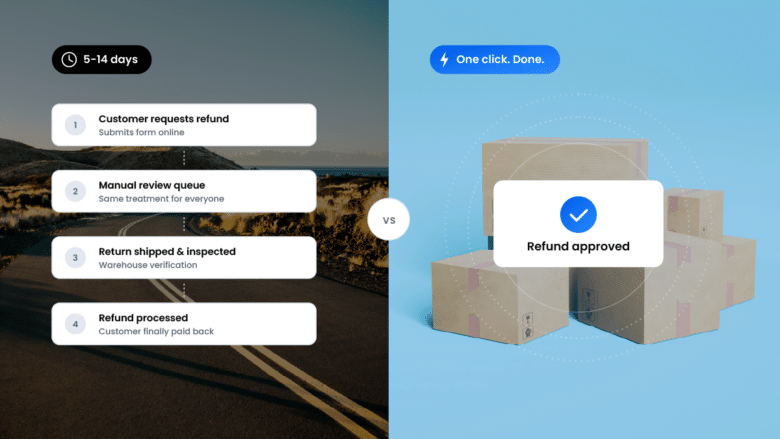
You already know what the right refund experience looks like. A loyal customer wants to return something. One click. Instant confirmation. Money back immediately. No forms, no waiting, no “your refund will be processed in 5 to 7 business days.”
You’ve wanted to offer this for years. Most CX leaders we talk to do. But every time the idea comes up, it runs into the same wall: “We can’t. The fraud team will block it. The abuse exposure is too high. It’s too risky.”
Those concerns are legitimate. But they’re not as immovable as they used to be.
What’s changed is simple. You can now know who’s asking, in real time, at the moment they request a refund. When you can’t tell the difference between a loyal customer returning a shirt that didn’t fit and a repeat abuser filing yet another INR claim, the only responsible option is to slow things down for everyone. Same process, same friction, same wait. But when you can tell the difference, everything opens up.
The abusers don’t give up when things are slow. But your good customers do stop coming back. Brands are now using the same identity signals that power checkout decisions to make smarter refund decisions. And the results are rewriting what’s possible.
Why this matters now
The refund moment is becoming the most important touchpoint in the customer relationship. Not checkout. Not delivery. It’s when a customer has a problem with their order that they find out what kind of company they’re really dealing with.
According to the NRF’s 2025 Retail Returns Landscape report, 76% of consumers say they’re more likely to choose a return option that offers an instant refund. And 71% say a poor returns experience will make them less likely to shop with a retailer again.
The commercial impact is just as direct. Research shows that customers who receive instant refunds have a 35% higher repurchase rate and spend 20% more on their next order. Repurchase rates drop by 60% when refund processing takes three or more days. And every refund that doesn’t happen instantly generates a customer service contact that costs money and erodes the relationship. One brand found that 99% of one-click refund orders required zero CS contact. Think about what that means at scale. Every day of refund delay is a loyalty tax you’re paying with your best customers’ patience.
One-click refunds aren’t just nicer. They’re a retention and revenue lever hiding in plain sight.
What’s really holding brands back
We’ve watched hundreds of brands wrestle with this. The objections are always sincere. But when you look closely, each one traces back to the same root cause: making decisions without knowing who’s on the other side.
At MRC 2026, merchants shared how they’re currently solving this problem: holding refunds on higher value items until the return is inspected back at the warehouse. The logic makes sense on paper. But think about who that actually affects. Your highest spenders get the worst refund experience. That’s the opposite of what good CX looks like.
“If we offer instant refunds, abuse will eat us alive.”
If you offered instant refunds to everyone as a blanket policy, then yes, you’d likely see a spike in abuse. That fear is well founded. Refund abuse is an €80 billion problem. It surged 64% between January 2024 and May 2025. Wardrobing alone accounts for roughly half of all fraudulent returns. Fraud-as-a-service operations are selling step-by-step refund guides on social platforms. AI-generated damage photos are making fake claims harder to spot. Nobody should be dismissive about the risk.
But the current approach isn’t working either. Refunds are slow because merchants need time to get the item back to the warehouse and inspect it. They need to verify it’s the genuine product being returned and not a counterfeit, an empty box, or something else entirely. That process exists for good reason. The problem is that it applies equally to everyone, whether you’re a loyal customer returning shoes that didn’t fit or someone who’s done this five times before.
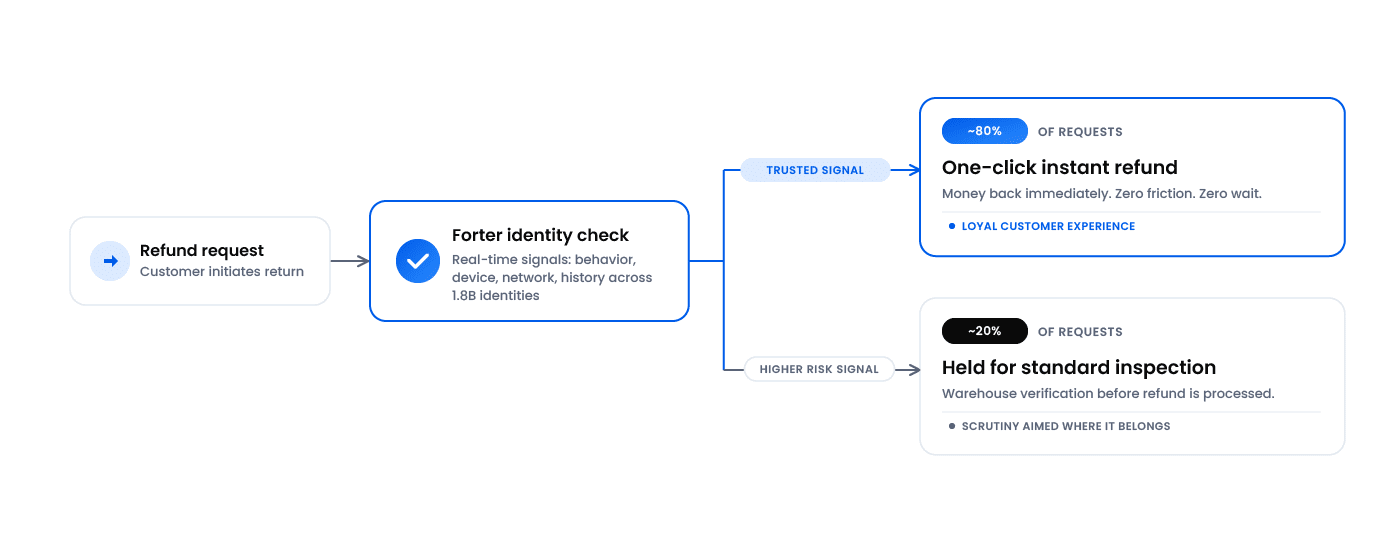
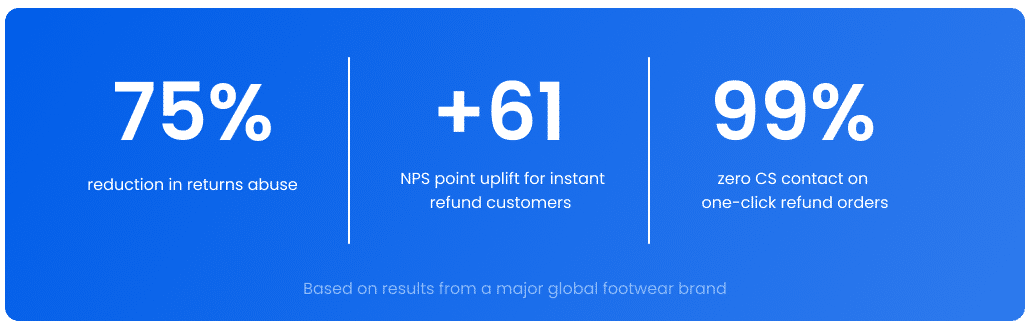
The brands seeing the best results aren’t choosing between speed and safety. They’re using identity context to give each customer the right treatment. A major footwear brand approved 80% of refund requests instantly for trusted customers, while holding the remaining 20% for standard inspection. Returns abuse dropped 75%. Scrutiny was finally aimed at the right people instead of being spread thin across everyone.
“Our best customers are getting the same experience as our worst ones.”
With one-click refunds, they don’t have to. Trusted customers get instant resolution while higher risk patterns are held for standard inspection. Same policy, different experience based on identity. Without that distinction, your three-year loyal customer whose shoes didn’t fit is stuck in the same refund queue as a first-time buyer running a wardrobing scheme. They don’t know that. They just know it took eight days to get their money back.
That same footwear brand? Customers who received one-click refunds scored 61 NPS points higher than those who went through the standard process. And 99% of one-click refund orders generated zero customer service contact. That’s not a marginal CX improvement. That’s a different relationship with the brand.
“My CFO will never go for this.”
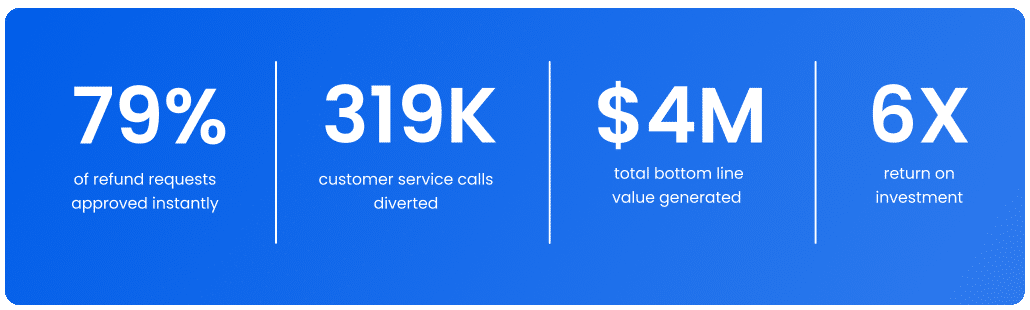
But the numbers from brands doing this are hard to argue with. A global sportswear brand approved 79% of refund requests for one-click processing. That diverted over 319,000 customer service calls and generated $1.5M in net OpEx savings in a single year. An apparel brand improved claims handling by 95.5%, contributing $12.4M to their P&L. The numbers speak for themselves.
One-click refunds pay for themselves through operational savings alone. This is usually where the idea dies inside an organisation. The CX team wants it. The fraud team is wary. The CFO asks, “What does it cost?” And because nobody has a good answer, it gets tabled.
“This sounds like a massive platform project.”
Brands are going live with one-click refunds in weeks, not quarters. It can be a big project, but it doesn’t have to be. If you already have identity or fraud signals at checkout, most of the foundation exists. Extending those signals to the refund moment is a new decision point on existing data, not a net new infrastructure build. The gap between “we should do this” and “we’re doing this” is smaller than most teams assume.
Measured impact across leading brands
A major footwear brand reduced returns abuse by 75% while approving 80% of refunds with one click. Customers in the one-click refund segment scored 61 NPS points higher and 99% of those orders required zero customer service contact.
An apparel brand improved claims handling by 95.5%, contributing $12.4M to P&L. NPS improved by reducing claim volume for legitimate customers.
A delivery platform blocked 900,000 abusive orders annually, saving $50M while keeping the experience completely frictionless for genuine customers.
The pattern is the same in every case. Better experience for good customers and less abuse, happening at the same time. Not a tradeoff. A compound effect.
The window is open
Consumer expectations are moving in one direction. 86% of shoppers now prefer returns with instant refunds. Amazon set the bar years ago and the rest of the market is being measured against it. At the same time, abuse is getting more sophisticated. AI is making fraud rings harder to catch with traditional rules. The space between what customers expect and what the threat landscape demands is widening.
The brands that close this gap first will build loyalty that compounds. The ones that keep running the same slow, cautious process for every customer will keep losing ground to the ones that can tell who’s who.
Most brands already have more of the pieces in place than they realise. The customer data, the behavioural signals, the identity intelligence from checkout. The distance between where you are today and one-click refunds for your most trusted customers is probably shorter than you’d expect.
That experience you’ve always wanted to offer? It’s not as hard as you think.
Get a Refund Experience Audit
We’ll analyse your current refund process and show you how much of your volume could qualify for one-click approval.